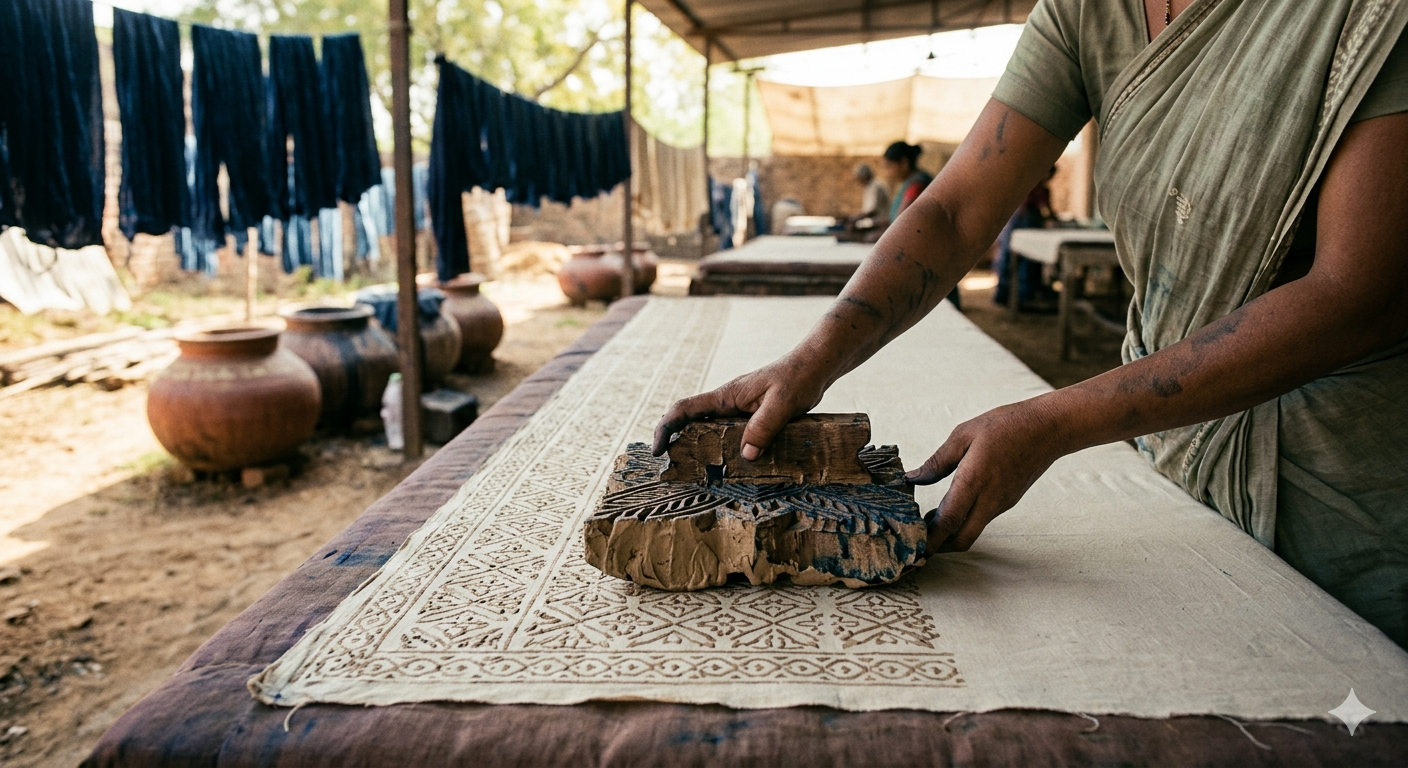
Deep within the vibrant state of Rajasthan lies Bagru, a historic town where time slows down to the rhythmic, comforting thud of wooden blocks meeting tightly stretched cotton cloth. This is the heart of India’s textile heritage, kept alive by generations of dedicated master craftsmen who refuse to let ancient techniques fade in an era dominated by fast fashion and synthetic mass production.
A 350-Year Heritage Reimagined
For centuries, the Chippa community of Bagru has perfected a complex relationship between nature and fabric. Unlike modern textile mills that rely on harsh chemicals and automated screen printers, traditional block printing is a fully organic, human-led choreography. Every piece of fabric tells a story of patience, passing through dozens of skilled hands before it is ever worn.
The process begins long before any color touches the cloth. Raw cotton is meticulously washed and treated with harda—a natural texturing agent derived from the myrobalan fruit. This crucial step gives the fabric its signature pale-yellow base tone and acts as a natural mordant, ensuring that the plant-based dyes bond deeply and permanently with the fibers.
The Alchemy of Dabu and Natural Dyes
At the core of this craft’s magic are two distinct elements: the legendary indigo vats and the ancient Dabu mud-resist printing technique.
- The Sacred Indigo Vat: Indigo dyeing is less of a manufacturing process and more of an art form. Deep, underground fermentation vats hold a living, breathing mixture of natural indigo plant extract, lime, and jaggery. Fabric is submerged into this dark, murky liquid; when it is pulled out, a magical chemical reaction occurs. The fabric initially emerges green, turning a brilliant, deep cosmic blue as it hits the open air and oxidizes.
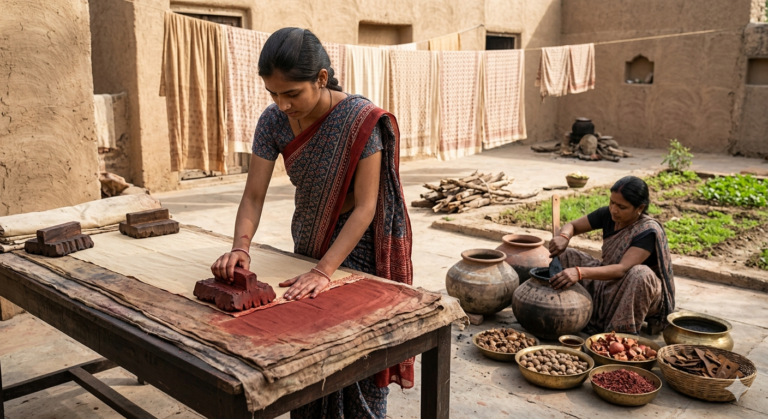
- The Mud-Resist (Dabu) Secret: To create intricate patterns against the dark blue background, craftsmen utilize the Dabu technique. A specialized resist paste made of local clay, wheat chaff, and gum arabica is mixed thoroughly and hand-stamped onto the cloth using intricately carved teakwood blocks. Sawdust is sprinkled over the wet mud to quicken the drying process. When the fabric is immersed in the indigo vat, the mud protects those specific stamped areas from the dye, leaving behind a crisp, beautiful contrast.
Balancing Tradition with Modern Sustainability
What makes this traditional craft deeply relevant today is its inherent, flawless commitment to sustainability. Every single ingredient used in a traditional workshop comes from the earth. Madder root creates rich reds, pomegranate rinds offer vibrant yellows, and iron filings mixed with molasses yield striking blacks. The water used in the washing processes is recycled into local fields, creating a fully circular, eco-friendly production cycle.
Today, master artisans are bridging the gap between rural heritage and global fashion. By collaborating with contemporary designers, they are adapting classic geometric and floral motifs onto modern silhouettes, proving that slow, conscious fashion can be incredibly stylish and universally appealing.
Keeping the Craft Alive
Every small imperfection in a hand-block printed fabric—a slight misalignment of a border or a faint variation in dye depth—is not a defect. It is the literal fingerprint of the artisan who made it. Supporting authentic hand-block printing means keeping a beautiful 350-year-old language alive.







Thank you, we will keep posting
Repudiandae voluptas omnis voluptatem velit quas aut quia
Thank you Dena
I will send you information
Error voluptatum quam dolore harum. Qui aliquid perferendis aut recusandae iusto. Exeid fuga aspernatur est dolores. Reprehenderit dolor non tenetur aut. Et facilis alias nihil nostrum et Exercitationem perspiciatis qui sit Consequatur vel ut placeat esse aut.
Velit ut voluptas magni autem in cum quidem. Fugit cupiditate velit ad. Sed vel autem itaque libero
Voluptas voluptatem soluta laboriosam dolorem explicabo ut ad molestiae. Esse eum sapiente veniam